Keyword Research in the Age of AI Overviews
A year and a half ago, an SEO friend told me he was thinking about quitting SEO entirely. "Google's going to answer everything itself," he said. "What's left for us?"
He didn't quit. The situation also turned out to be more nuanced than that. But the question was real, and I think about it often when I'm doing keyword research now. AI Overviews and AI-generated answers, both in Google and in the standalone chatbot context, have genuinely changed which keywords are worth pursuing. Not in the apocalyptic way that 2024 headlines predicted. In a more boring, structural way that's easy to miss if you're not paying attention.
This post is what I've actually changed about my keyword research workflow in response.
The shift, briefly
Before AI Overviews became prevalent, the SEO playbook for blogs was relatively stable. You found a low-competition keyword, you wrote a comprehensive piece answering it, you got the traffic. Even very basic factual queries ("how tall is the Eiffel Tower," "what is the boiling point of mercury") routed at least some traffic to websites that had answered them.
That category of traffic is mostly gone. For pure factual queries, Google now answers in the AI Overview box, and the click-through to underlying websites is much lower than it used to be. The drop varies by niche but for informational queries with simple answers, my estimate is somewhere between a 40% and 70% reduction in clicks compared to 2023.
This is not a death knell for content sites. It's a reshaping. The keywords that survived are different from the ones that didn't.
Three categories of keywords today
I now sort potential keyword targets into one of three buckets, and I think about them very differently.
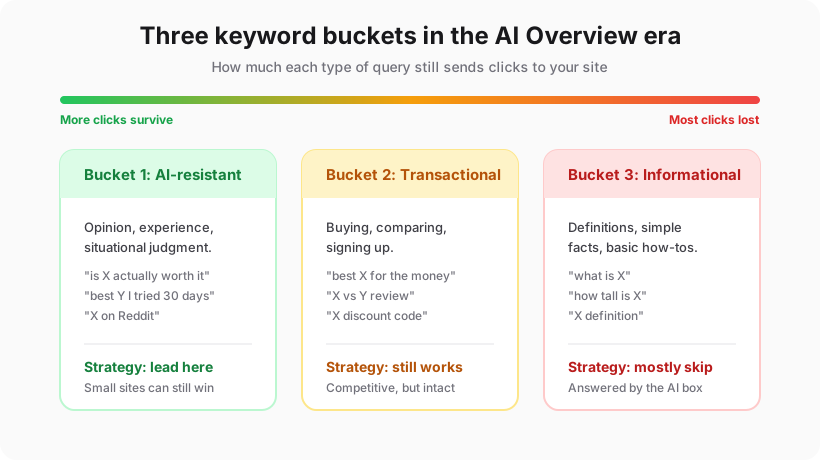
The mental model I run every keyword through now. The further right a query sits, the more of its clicks the AI Overview box is quietly absorbing.
Bucket 1: AI-resistant
These are keywords where users want depth, opinion, or experience that a generated summary can't credibly provide. They tend to share certain characteristics:
- The query implies a need for a perspective ("is X actually worth it," "what's the best Y for my situation").
- The answer requires testing or first-hand use ("the best Y I tried for 30 days").
- The query is about something niche enough that AI summaries are unreliable or hallucinated.
- The query is community-flavored ("X on Reddit," "X forum discussion").
For these keywords, AI Overviews actually help small content sites. Google still shows the AI summary, but users frequently don't trust it for these query types and click through to read what humans wrote. In some cases the click-through rate has gone up because the summary fails to satisfy the query and users scroll down hunting for real opinions.
If you're starting a content site today, your strategy should be heavily weighted toward Bucket 1.
Bucket 2: Transactional / commercial
Keywords about buying things, comparing products, or signing up for services have not been hit as hard. AI Overviews summarize, but they don't usually take you to a checkout page. Affiliate sites and product review content still capture much of this traffic.
This bucket is highly competitive (it always was), and the AI shift hasn't changed that. If you can win here, you can still build a substantial business. The keyword research mechanics are largely unchanged.
Bucket 3: Pure informational
These are the keywords that have lost the most. Definitions, basic how-tos, simple factual questions, list-style overviews of well-trodden topics. The AI Overview answers them and the click-through is a fraction of what it was.
I now avoid Bucket 3 as a target unless I'm writing it as part of a topical cluster around a stronger Bucket 1 or Bucket 2 piece. A standalone "what is X" post is, in my opinion, no longer worth writing as a traffic-generation strategy in 2026. Write the same content as a section inside a larger, more defensible piece.
What this means for keyword discovery
The discovery mechanics haven't changed much. Autocomplete still works. The SERP analysis still works. (Those fundamentals are covered in how to find long-tail keywords and five keyword research habits.) What's changed is the filtering layer at the end.
When I evaluate a potential keyword now, I add one extra question to my old workflow: "Will this query be satisfied by an AI Overview?" If yes, demote it heavily. If no, consider it normally.
A few practical heuristics I've developed for spotting AI-resistant queries:
- Queries containing "actually," "real," or "honest" often imply a need for first-hand perspective.
- Queries about experiences over time ("after a month of," "long-term review of") imply something AI can't simulate.
- Queries about decisions in specific contexts ("X for someone who already has Y," "X for small apartments") imply situational judgment.
- Queries with comparative ambiguity ("Reddit thinks X but YouTubers say Y") imply users want to weigh perspectives.
When I'm building a keyword list, I now actively look for queries with these properties.
A specific change to my title strategy
This one is small but I think it's mattered. Titles that signal first-hand experience or strong opinion now outperform titles that signal comprehensive summary.
Compare:
- "Complete Guide to X" (pre-2024 darling, increasingly ignored)
- "I tried X for 30 days. Here's what happened." (resonates much more in 2026)
The first is what comprehensive blog posts used to be titled. AI Overviews now provide a serviceable version of that for free, so the format is less differentiated. The second signals "this is content the AI summary cannot fully replace," which is the implicit promise users are now looking for.
I'm not saying to never write comprehensive guides. I'm saying the framing should usually be different. "What I learned writing a comprehensive guide to X" works. "Complete Guide to X" is increasingly a category that loses to AI summaries.
What about content optimized for AI itself?
There's a small cottage industry now of consultants who claim to optimize content "for AI Overviews," meaning structuring your page so that AI systems are more likely to cite or summarize it. I am skeptical of most of this advice.
A few honest observations:
The mechanics of how AI Overviews choose sources are not publicly documented and seem to involve a lot of randomness. Anyone who claims to know precisely what gets cited is overconfident.
When your page is cited, the click-through is still significantly lower than it was for traditional first-page rankings. Getting cited is not the same as getting traffic.
The page structure recommendations being sold ("use clear question-answer formatting," "include explicit summaries") are mostly things you should be doing anyway because they're good for readers. The AI angle is mostly a re-skinning of decade-old advice.
I do think clear structure and explicit answers in your content help. I just don't think they constitute a new discipline. Write clearly, answer the question directly, structure your headings logically. This was always good advice.
What I'd do if I were starting today
If you're starting a content site in 2026 and you have to make hard choices about which keywords to chase, here's the order I'd suggest:
-
Lead with Bucket 1 (AI-resistant) keywords. Opinion-driven, experience-flavored, situational. This is where small sites can still grow rapidly.
-
Mix in Bucket 2 (commercial) where you have a credible angle. Affiliate posts and product reviews still work but the bar is high.
-
Mostly skip Bucket 3 (pure informational) as standalone targets. Use it as filler inside larger pieces.
-
Lean into formats AI cannot easily reproduce: video, original screenshots, original photography, podcast-flavored long-form, first-hand data. (This is part of why I think YouTube is a strong bet right now.)
-
Build an audience that comes back directly, not just through search. The single best hedge against AI-driven search disruption is having readers who type your URL into the address bar instead of finding you via Google.
Number 5 is the underlying point. The search-driven content model worked for a long time, and it still works, but it's structurally weaker than it was. If you're investing serious time in content, invest some of it in turning random search visitors into something stickier, like email subscribers or returning readers.
To answer the question my friend asked
Is there something left for SEO? Yes. It's smaller and weirder than it was. The keywords that survive are the ones that benefit from a human writer's perspective, opinion, or first-hand experience. The work has gotten more interesting, in my opinion, even if the traffic numbers have come down.
The era of writing comprehensive guides to extract clicks from informational queries is mostly over. The era of writing things AI cannot credibly fake is just getting started, and frankly, that's a better era to write in.