Five Keyword Research Habits That Actually Moved the Needle for Me
If you've read one "10 Keyword Research Tips for Bloggers" post, you've basically read all forty of them, and I think I have. They recite the same checklist (use autocomplete, check competitors, mind the volume) without ever telling you which steps still matter after you've been at this for a couple of years and which ones quietly fall away.
So here's a different cut. Five habits, ranked by how much they've genuinely changed my numbers, not by how good they sound in a listicle. And where I think something is overrated, I'll say so plainly.
1. Mining autocomplete recursively, not once
Everyone says "use Google autocomplete." Fine. The version that actually works is using it recursively.
What that means in practice: you type your seed, you write down the suggestions, and then you take each of those suggestions and type those in to see what their suggestions look like. After two or three rounds of this you have a tree, not a list. The leaves of the tree are where the actual writable topics live.
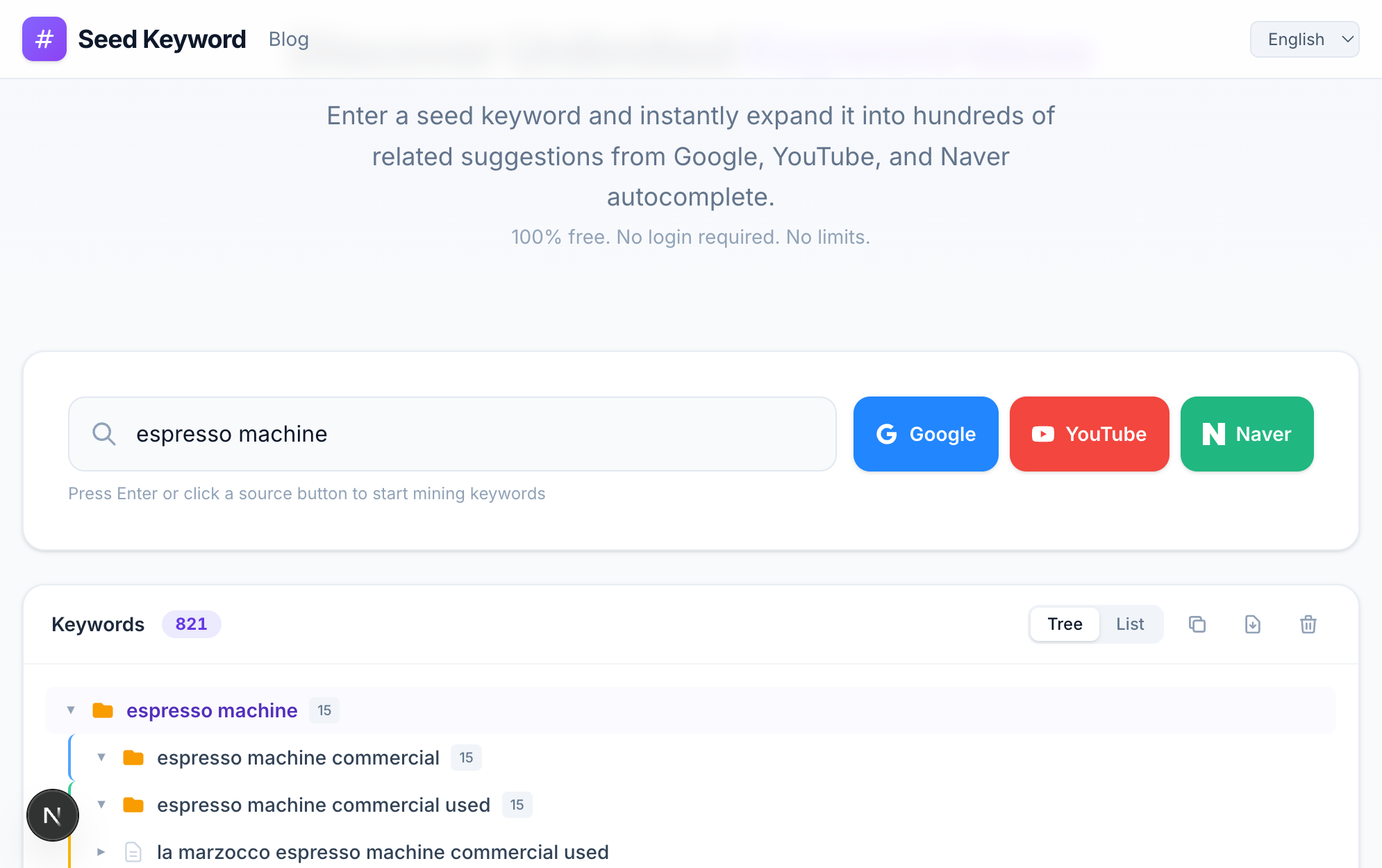
I mean "tree" literally. The broad branches near the top are too competitive to bother with. The leaves at the bottom — the four- and five-word phrases — are where a small blog can actually win.
You can do this by hand if you have a free afternoon. I did that for about a month before I built a tool to automate it, which honestly is how Seed Keyword came to exist in the first place. Whether you do it by hand or with software doesn't matter as much as understanding the principle. One pass = surface ideas. Three passes = content briefs. (If the term "seed" itself is fuzzy, start with what seed keywords actually are.)
2. The "would I actually click this?" filter
This one's my favorite because it's free and obvious in retrospect.
When you finish your keyword research and you have a list of 200 phrases, go through them and ask: if I saw this exact phrase as a Google result, would I click it? Not "is this a real search," not "does this have volume." Just: would I click.
A lot of keywords pass volume and competition checks but fail this test. "Best budget laptops" sounds good until you imagine the SERP, which is going to be five identical listicles from CNET, Wirecutter, and similar. You're not going to outrank them, and even if you did, the click is going to the brand they trust.
Whereas something like "do refurbished MacBooks lose value faster" is a question with a real person behind it. The SERP for that is messier, the intent is clearer, and your independent take has a fighting chance.
I run every keyword list through this filter now. It cuts about 60% of the list and improves the quality of what's left dramatically.
3. KGR (the keyword golden ratio), used with skepticism
KGR is the formula where you divide the number of allintitle:"your keyword" results by the monthly search volume, and if the result is under 0.25, the keyword is supposedly "golden."
I'm including this because it works often enough to be worth mentioning. But I'll be straight with you: I think it's slightly overrated as a method. The original guide pitched it as a way to find low-competition keywords quickly, and it does that, but the keywords you find tend to be very low-volume and the volume estimates themselves are notoriously unreliable.
My modified version: use KGR as a tiebreaker, not a filter. When you have two long-tails that both pass your gut check, look at the KGR. The lower one is probably easier to rank for. But don't sort your entire list by KGR and just write the top of the list. You'll end up with a blog that ranks for things nobody actually searches enough to matter.
4. Reading the SERP, not just the keyword
The keyword tells you what people type. The SERP tells you what Google thinks the answer should look like. These are not always aligned, and that gap is where most of your strategic decisions actually live.
Take "how to start a podcast." If you search it, the first page is dominated by long, comprehensive guides from established media sites. The SERP is telling you "we expect a 5,000-word definitive guide here." If you publish a quick 800-word answer, you're not even in the conversation, regardless of how good your on-page SEO is.
Conversely, search "podcast hosting reddit" and you'll see Reddit threads, forum posts, and short opinionated answers. Google has decided this query wants community wisdom, not a polished editorial guide. If you write a polished editorial guide for that query, you'll lose to a thread with 12 upvotes.
So before you commit to a keyword, search it. Look at what's ranking. Match that format, or have a really good reason to deviate.
5. Keeping a "later" file
This is the most boring habit on the list and possibly the most valuable.
Every time you find a keyword that's interesting but not what you're working on right now, write it down in a single text file. Don't organize it. Don't categorize it. Just dump it. After six months you'll have something like 300 entries, and a non-trivial percentage of them will be better content ideas than anything you came up with in a planning session.
I called mine ideas.txt for two years. It currently has, I just checked, 487 lines. About a quarter of those have become posts. The rest will probably never be written, and that's fine, because the cost of saving them was approximately zero.
What I left out
I deliberately didn't include "competitor gap analysis" or "Google Trends for seasonality" on this list. They're fine techniques but I think they're less impactful than they sound for most bloggers under 50,000 monthly visits. Competitor analysis assumes you can outrank competitors, which mostly requires authority you don't have yet. Seasonality is real but the upside is small unless you're in a deeply seasonal niche.
Spend your time on autocomplete mining, the click filter, and reading the SERP. Those three alone, done consistently, will outperform fancier strategies for the first year or two of a content site. (The free, step-by-step version of this workflow is in finding long-tail keywords without spending money.)
The fancier stuff can wait until you've got something working.