Finding Long-Tail Keywords Without Spending Money
You already know why long-tail keywords are worth chasing. Lower competition, higher conversion intent, easier wins for a small site. It's the most rehearsed argument in SEO and I'm not going to repeat it back to you.
The part nobody covers honestly is the finding. Most guides hand you four methods and present them as equals, as if a checklist were the same as a strategy. They aren't equals. A couple of them carry the whole load. The rest are theater. So instead of a tidy list, here are the methods I actually reach for, ranked by how much I trust them.
The one method that does most of the work
Autocomplete mining is, by a wide margin, the most useful free method for finding long-tail keywords. If you only learn one technique, this is the one.
The reason it works so well is that autocomplete data is unfiltered evidence of real searches. It's not a guess about what people might search. It's a record of what they did search. Google won't put a phrase in autocomplete if it doesn't have meaningful query volume.
The trick is to do it recursively. Most people do one pass: they type their seed, get ten suggestions, and stop. That's not how the value compounds. You need to take each of those suggestions and use it as a new seed. After three passes you have hundreds of phrases that contain real intent. (If the idea of a "seed" is new to you, read what seed keywords are first.)
Here's what that recursion actually looks like once it's running. This is a single seed expanded a few levels deep:
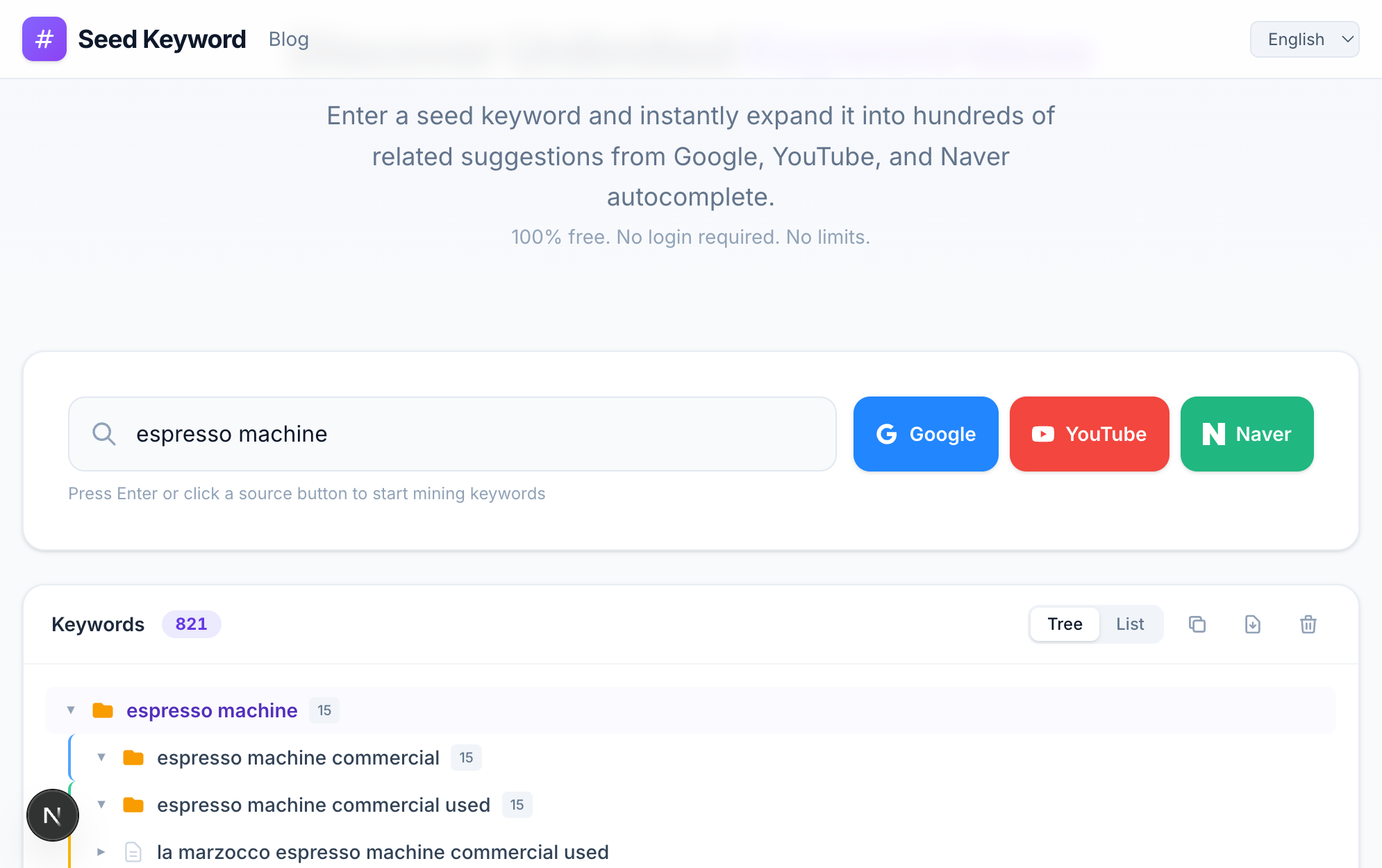
Each node is a real autocomplete result, and each one becomes the seed for the next pass. That's where the "hundreds of phrases" comes from — you're not typing them, the recursion is.
A few specifics that make this more effective:
- Use letter prefixes. Type "espresso machine a," "espresso machine b," and so on. You'll get different suggestions for each letter, which is how you systematically expand coverage. Autocomplete tools mostly automate this.
- Use question prefixes. "How to," "why is," "what is," "can you," "should I." Question-form long-tails are extremely valuable because they map cleanly onto blog post titles and Google's "People Also Ask" boxes.
- Mine multiple sources. Google, YouTube, and Naver have separate autocomplete databases. A long-tail that's hot on one might not exist on another.
For most niches, two hours of recursive autocomplete mining will give you more content ideas than you can write in six months.
A method that's good but slightly oversold
"People Also Ask" boxes are useful. They're not as powerful as the SEO community makes them sound.
Here's the issue: PAA questions are pulled from across the web, including from already-ranking pages. So if you target the question, you're often competing with the page that already answered it well enough to be quoted by Google in the first place. The PAA box isn't a list of unanswered questions. It's a list of questions Google has already found acceptable answers for.
This doesn't mean ignore PAA. Just use it the right way. The right way is:
- As inspiration for related angles, not as a direct target list.
- As a way to understand the parent topic's question landscape before you commit to a piece.
- As a source for FAQ sections within a larger article, where you address several related questions in one post.
I rarely target a PAA question as the sole focus of a piece anymore. The conversion of effort to traffic is worse than autocomplete-mined long-tails.
A method I think is wildly overrated
The "alphabet soup" technique, where you literally type your seed followed by each letter of the alphabet, gets mentioned in every long-tail keyword article. It's not bad. But it's just a primitive version of autocomplete mining.
If you have an autocomplete tool that does recursive expansion, alphabet soup gives you nothing new. The tool already covers it. If you don't have such a tool, alphabet soup by hand is fine but you should be aware that you're doing a manual version of an automatable process. Don't treat it as a distinct strategy.
A method I keep forgetting about, but shouldn't
Forums. Reddit, Quora, niche-specific forums, Discord communities. Reading them is one of the highest-leverage things you can do for keyword research, and I keep underusing it.
The reason it's so valuable: forum conversations reveal the exact phrasing people use when they're not trying to sound like a search query. People in a coffee subreddit don't ask "what is the best burr grinder under 200 dollars." They ask "is the Baratza Encore actually worth it or should I just save up for a 1Zpresso." The latter is a real query intent that no keyword tool will surface because nobody types it into Google in that form.
These conversations give you two things:
- Topic ideas that haven't been done to death yet.
- The exact vocabulary your audience uses, which you should use in your titles and headers.
This is slower than running a keyword tool. It's also one of the few moats left in SEO content. Tools democratize the keyword discovery half. Reading actual humans is what separates content that resonates from content that's technically optimized but lifeless.
What about Google Search Console?
If your site is already getting some traffic, Search Console is an underused source of long-tail keywords. Look at the queries you're appearing for in positions 11 through 30. Those are keywords where Google has already decided your page is relevant enough to consider, but you're not on the first page yet. They're often easier wins than starting from scratch.
This obviously doesn't help if you're at zero traffic. But once you have a few months of impressions, GSC becomes one of the best free keyword tools you have access to, and it's worth getting every post indexed there from day one. (For more on when free tools are genuinely enough, see Ahrefs vs free tools.)
Putting this in order
If I had to start a content site from scratch today and could only use free tools, here's how I'd actually do it:
- Pick three seed topics I can write about confidently.
- Run recursive autocomplete mining on each, across Google, YouTube, and Naver where relevant. Build a list of 200+ long-tails.
- Read forum threads in those topics for a couple of hours to understand how the audience actually talks.
- Filter the keyword list against my "would I click this" gut check.
- Write ten posts, hitting publish on each one before moving to step 6. (The habits that make this step pay off are in five keyword research habits.)
- After three months of indexing, open Search Console and look at the impression data to find low-hanging fruit on second-page rankings.
- Write the next ten posts targeting those gaps.
That's it. No paid tools, no subscriptions, no fancy techniques. The pieces are obvious. The hard part is doing all of them consistently for the time it takes to compound.
Long-tail SEO is mostly a patience problem disguised as a discovery problem. The methods above will give you more keywords than you can act on. Acting on them is what most people fail at.