Seed Keywords: The One Concept I Wish I'd Understood Earlier
Ask me to define "seed keyword" five years ago and I'd have given you a textbook answer. Ask me to actually use the concept well, and I'd have stared at you blankly. There's a gap between knowing the term and understanding it, and I lived in that gap for an embarrassingly long time.
The symptom looked like this. I'd open Ahrefs, type "fitness" into the explorer, get hit with 200,000 keyword ideas, and freeze. Where do you even start? That paralysis is the exact thing seed keywords are supposed to fix. Once it finally clicked, the whole workflow felt almost too simple to have taken me a year.
A seed keyword is just a question you could fit on a napkin
The definitions you'll read online ("a broad foundational term," "the root of your keyword research tree") aren't wrong. They just make the idea sound heavier than it is.
So here's the version I'd give a friend. A seed keyword is the rough topic you'd blurt out if someone asked what your site is about. Home workouts. Espresso machines. Korean grammar for English speakers. That's the whole thing. Don't agonize over the wording. You're going to feed it into a tool that mines variations, and the variations are the stuff you'll actually write about.
The mistake I made for a long time was treating the seed itself as the target. I'd try to rank for "home workouts" directly, get crushed by sites with a decade of domain authority, and conclude that SEO was a scam. It wasn't. I was just starting from the wrong end of the funnel.
What seeds are actually for
The point of a seed is not to rank for it. The point is to use it as a query into autocomplete data so you can see what real people are typing.
Take "espresso machine." On its own that's a brutal keyword to chase. But pipe it through autocomplete and feed each result back in as a new query, and the thing branches into a tree. Here's an actual run from the tool I use, starting from that one seed:
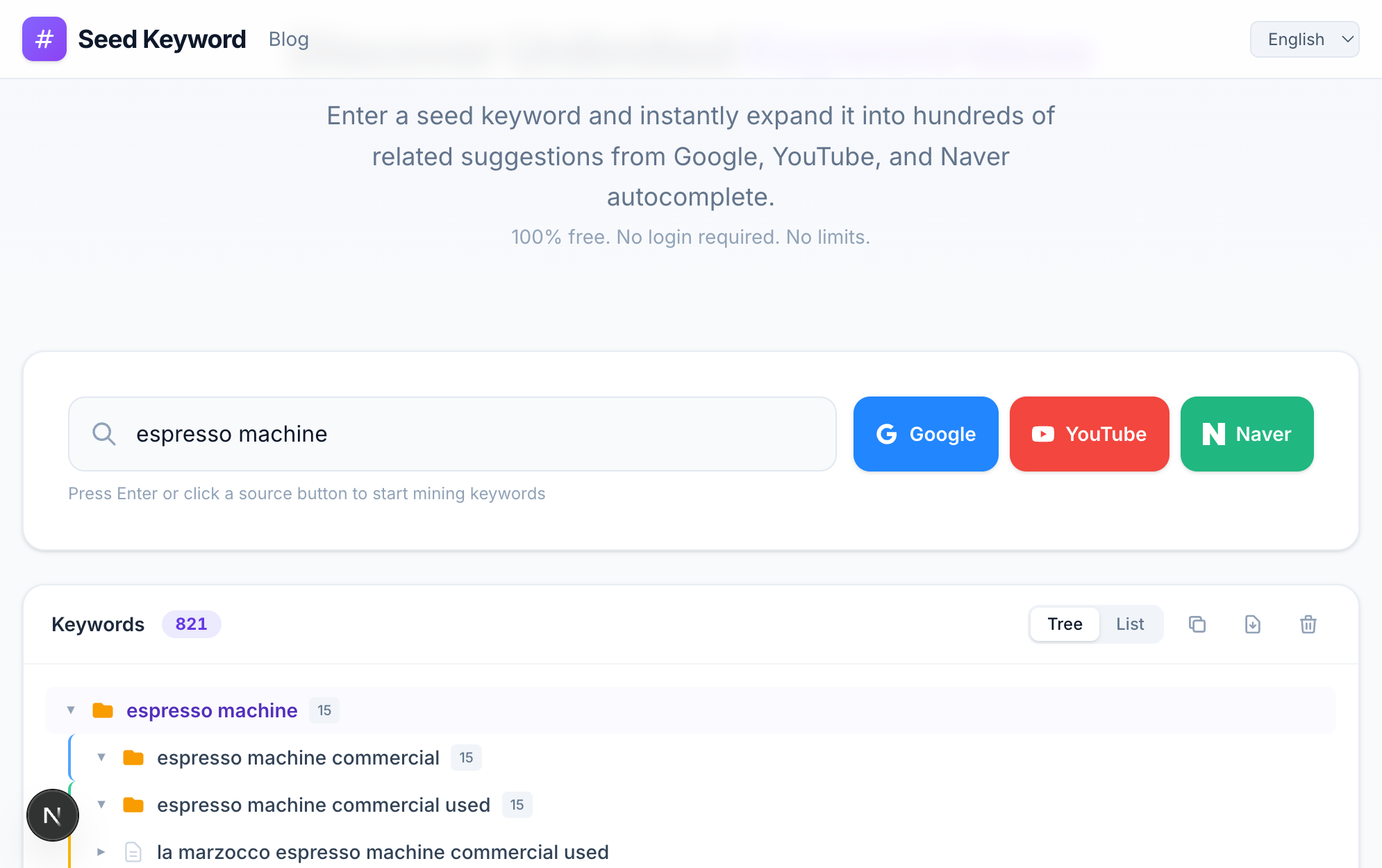
One seed, three levels deep. Notice how "espresso machine → commercial → commercial used" keeps surfacing more specific phrases the further down you go.
You end up with things like (I cover how to mine these systematically in how to find long-tail keywords for free):
- espresso machine for small kitchen
- espresso machine that uses pods and grounds
- espresso machine vs french press cost
- espresso machine descaling vinegar
Now you're looking at actual sentences from actual people. Some of those sentences are content briefs in disguise. "Espresso machine that uses pods and grounds" is somebody who can't decide between two formats and wants someone to make the case for them. That's a 1,500-word post that practically writes itself.
This is the part I missed for an entire year. I kept staring at the seed, when the value was always one layer down.
How I pick seeds now
I keep it pretty boring. Three rules:
Pick something you can talk about for an hour without prep. If you can't, the long-tail variations will eventually require expertise you don't have, and you'll start writing the kind of thin, AI-flavored content Google actively penalizes now.
Don't overload the keyword with adjectives. "Best budget espresso machine under 200 dollars" is not a seed. It's already a long-tail. You won't get good variations because there's nothing left to vary.
Use the language your readers use, not the language insiders use. Fitness people say "lifting." Beginners say "weight training." Beginners do more searches. Optimize for the latter unless your site is explicitly for the former.
That's pretty much it. If I have a content site about woodworking, my seeds might be "woodworking projects," "wood types," "table saw," "pocket hole," "shellac finish." Five seeds, one afternoon of mining, and you can plan a quarter of content.
A common objection
"But surely the seed has to be a high-volume keyword to be useful?"
Not really. Volume on the seed is mostly irrelevant because, again, you're not trying to rank for it. What matters is whether the seed produces a rich tree of variations. A seed with 200 monthly searches that branches into 400 long-tails is more valuable than a seed with 200,000 searches that's so broad it doesn't branch into anything specific.
The clearest sign of a good seed is that the autocomplete tree feels generative. You can keep pulling on threads. If a seed gives you 30 boring variations and that's it, it's probably too narrow already.
One more thing nobody tells you
The autocomplete database for Google is not the same as the one for YouTube, and neither is the same as Naver's. I learned this the hard way after writing what I thought was a great YouTube-first piece, only to realize I had been mining Google data the whole time. The keywords looked plausible. Nobody was searching for them on YouTube.
If you're going to do this seriously, mine each platform separately. The overlap is smaller than you'd think. I get into the platform-specific quirks in the Naver SEO guide and the YouTube keyword research guide.
So that's the whole concept, minus the dressing. Seeds are dumb starting points. The smart part is what comes after. If the only thing you take from this post is "stop trying to rank for the seed," that's enough.