Ahrefs vs Free Tools: An Honest Comparison from Someone Who Uses Both
I pay for Ahrefs. I also built a free keyword research tool. That puts me in a slightly weird position to write this post, but it also means I have no incentive to oversell either side. Let me try to give you a comparison that isn't downstream of an affiliate link.
The short version: Ahrefs is genuinely excellent and probably the best SEO tool available. It's also expensive enough that for the majority of individual creators and small site owners, it's not the right purchase. Free tools cover more of the workflow than the SEO marketing machine wants you to believe.
The longer version follows.
What Ahrefs is actually for
Ahrefs is, at its core, a database of links and a database of keyword rankings, both updated frequently and at scale. Everything else they sell (Site Explorer, Content Explorer, Rank Tracker, etc.) is essentially a different interface on top of those two datasets.
Where this actually shines:
Backlink analysis. This is the thing nothing free comes close to. If you want to see who's linking to a competitor, when they linked, and what the link quality looks like, Ahrefs is the standard. Free alternatives exist but the data quality and coverage are not in the same league.
Competitive analysis at scale. Pulling a competitor's top organic pages, seeing what keywords those pages rank for, sorting by traffic. You can manually do parts of this for free. Doing it for ten competitors in an afternoon requires Ahrefs (or Semrush, which is similar).
Tracking a lot of keywords over time. If you need to monitor 200 keyword rankings across 5 sites with daily updates, free options don't really exist.
Domain authority estimation. Their DR metric is proprietary and imperfect, but it's a reasonable shorthand for site authority and it's hard to replicate at home.
What Ahrefs is not actually that much better at
This is the part the marketing doesn't emphasize.
Keyword discovery. Ahrefs has a great keyword discovery interface. But for the discovery step specifically, autocomplete-based free tools are competitive, sometimes better. The reason is that Ahrefs draws keywords from its database of "things people have searched at scale," which biases toward well-established queries. Autocomplete data surfaces newer, more conversational, more long-tail queries that haven't yet shown up in big keyword databases. For finding fresh long-tails, I sometimes prefer free autocomplete tools to Ahrefs. (My full method is in how to find long-tail keywords for free.)
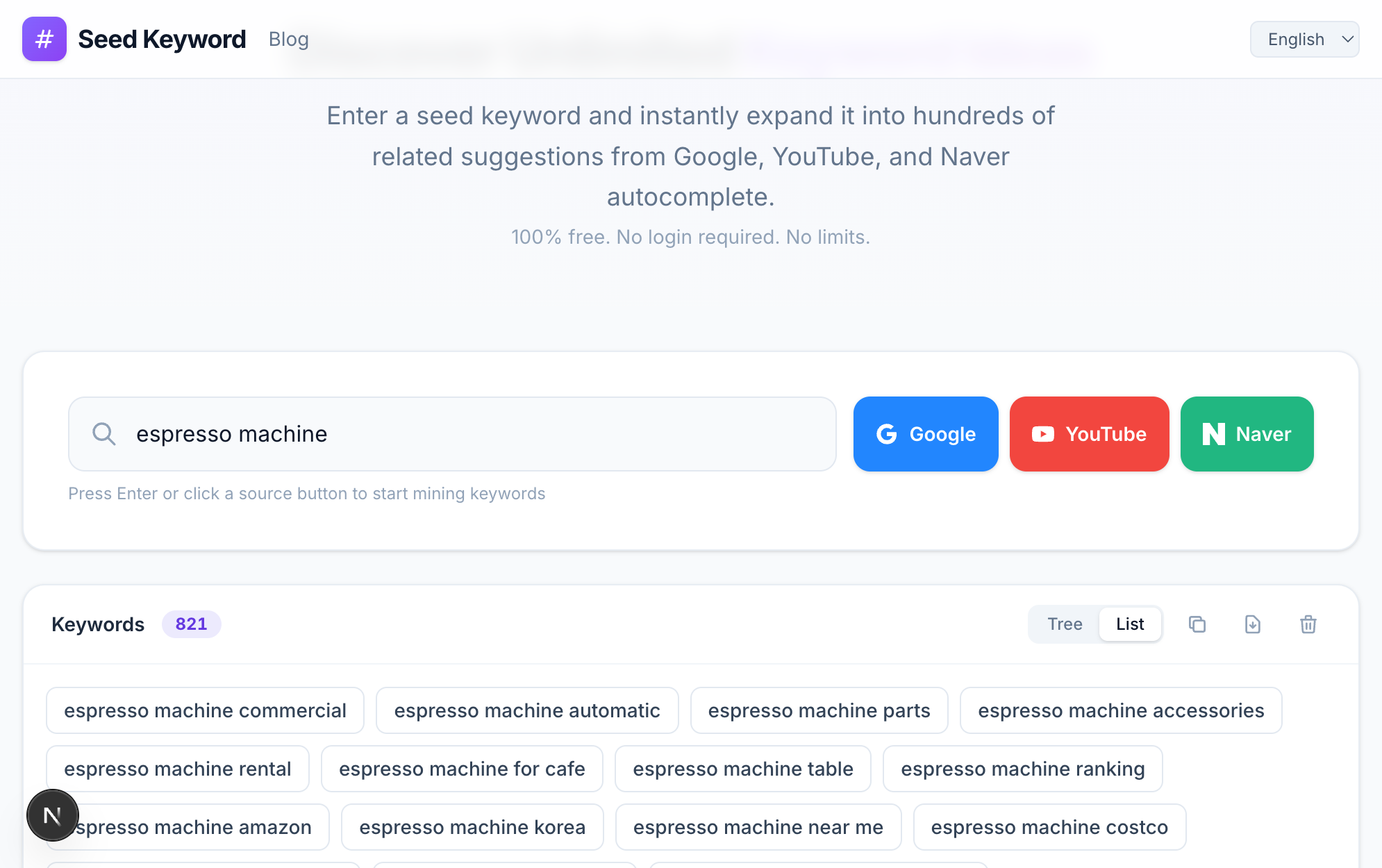
This is a free autocomplete tool after one click — hundreds of suggestions, no account, no quota. For the pure discovery step, this is genuinely competitive with the paid interface, and occasionally surfaces phrases the big databases haven't caught up to yet.
Keyword volume accuracy. All keyword tools have estimated volume, and the estimates disagree with each other often. Ahrefs is no better than Semrush, which is no better than free tools that estimate from autocomplete signals. The numbers are useful for ranking keywords against each other, not as absolute truth. People treat them as more reliable than they are.
Search intent classification. Ahrefs tries to label intent (informational, commercial, transactional, etc.) and it gets it right maybe 70% of the time. You should check it yourself anyway. Doing it yourself with a free tool is not meaningfully harder.
Multilingual coverage. Ahrefs has weaker data for non-English markets. Korean, Japanese, and many smaller European languages have spottier coverage than the English database. For Korean keyword work specifically, I get better autocomplete data from free tools that hit Naver directly than from Ahrefs. (More on that in the Naver SEO guide.)
When Ahrefs is worth the money
I'll be specific. Pay for it if:
- You're doing SEO professionally for clients or as a full-time job.
- You're running a site that does at least mid-five-figure monthly traffic and you need backlink monitoring.
- You're competing in a niche where understanding competitor backlink profiles materially affects your strategy.
- You have a team that needs shared access to data and reports.
In any of these cases the price is easy to justify. Even the lowest tier pays for itself with one client or one well-executed competitive analysis.
When you should stick with free tools
Pay for nothing if:
- You're under your first year of content publishing.
- You have under 10,000 monthly organic visits.
- Your main blocker is "publish more content," not "understand the competitive landscape." This is true for most small sites and they don't realize it.
- Your niche is small enough that the major paid tools don't have great data for it anyway.
In these cases, what you actually need is:
- A free autocomplete-based keyword tool (there are several; I obviously like the one I built).
- Google Search Console (free, official, and underused).
- Google Trends (free, useful for seasonality and rising topics).
- A spreadsheet.
That toolkit costs zero dollars and covers the workflows that actually move your traffic at the early stages.
What I do personally
I pay for Ahrefs because I do enough client work and competitive analysis that the price is trivially worth it. But I still use free tools alongside it for the keyword discovery step, because the autocomplete-driven approach surfaces things Ahrefs misses, especially in non-English markets and for long-tails.
Specifically, my workflow is:
- Start with autocomplete mining for the topic, using free tools, across the platforms my audience uses.
- Take the resulting keyword list into Ahrefs to check volume, difficulty, and SERP composition for the most promising candidates.
- Use Ahrefs' Content Explorer to see who else is ranking in the space and how they're doing it.
The free tools do the divergent thinking. Ahrefs does the convergent thinking. They're complementary, and you can do step 1 well before you need to pay for step 2.
A common pricing mistake
I see a lot of people in SEO Twitter and indie hacker communities subscribe to Ahrefs (or Semrush, or both) before they have any content. They use it for a month, get overwhelmed, and either keep paying out of guilt or churn out feeling like SEO is too complicated.
The reality is that no keyword tool will tell you what to write. They give you data. The decisions are still yours. If you don't have a clear topic strategy, more data doesn't help. It hurts, because it gives you more to overthink.
So the actual order of operations should be: figure out your niche and a workable content angle, write 10-20 posts using free tools, see what gets traction, then evaluate whether paid tools will help you scale what's already working. Most people do this backwards. They buy the tool first, hoping it'll tell them what to do.
The honest summary
Ahrefs is excellent and worth paying for in specific situations. Free tools are better than their reputation suggests, especially for the early-stage workflow most readers of this post are probably in. Don't let SEO content (often produced by people incentivized to recommend the paid tools) convince you that you need to pay for software before you've written your first 20 articles.
Start free. Get to the point where free is actually the bottleneck. Then pay. Most people never reach that point, which means most people never need to pay.