Naver SEO for People Who Already Know Google SEO
Most English-language guides to Naver SEO are written by people who have read about Naver. As someone based in Korea who has spent years using both Google and Naver as actual search engines, I want to give you the version that assumes you already understand Google SEO and just need to know what's different.
If you already know what title tags are and what backlinks do, this is for you. If you don't, go learn Google SEO first, and maybe start with what seed keywords are. Naver builds on the same underlying ideas, but with significant local twists.
The thing that confuses most foreigners about Naver
Google is a search engine. Naver is closer to a portal that happens to also have search.
When you search something on Google, you get a list of websites. When you search on Naver, you get a stack of sections: Power Link ads, View (Blog and Café posts), Knowledge iN Q&A, News, Shopping, Image, and Web. Each section has its own ranking system, and the Web section, the one most similar to Google's results, is often pushed below the fold.
This matters because optimizing your external website for Naver, in the way you'd optimize for Google, is fighting for visibility in a section most users never scroll to. If you want to actually be seen by Naver users, you usually need to have a presence inside Naver's own platforms. Especially Naver Blog and Naver Café.
This is the part most international SEO advice glosses over, and it's the biggest reason "we optimized for Naver and got nothing" stories happen.
What ranks where
Roughly speaking, the sections show up in this order on most queries, though Naver does dynamically reorder based on intent:
- Power Link ads (paid)
- View (Blog + Café, mixed)
- Knowledge iN (Q&A)
- News
- Shopping
- Image / Video
- Web (the section most like Google results)
So the practical Naver SEO question for a given query is not "how do I rank #1" but "which section do I want to rank in." For most marketers reaching Korean consumers, the answer is View, because it's high on the page and feels native to Korean reading habits. Korean users are extremely conditioned to scroll to the blog section first.
What Naver actually rewards in the View section
The View section is mostly Naver Blog and Naver Café posts. The ranking signals are not fully documented, but from years of watching what wins, here's the rough hierarchy:
Freshness. Naver is brutal about recency. A blog post from three weeks ago will often outrank a more comprehensive post from a year ago. This is the opposite of Google's "evergreen content compounds" model and it changes how you should plan content. Naver rewards regular publishing more than depth.
On-blog signals. Naver has its own quality scoring for blogs, which looks at things like posting frequency, time on page from Naver users, image inclusion, and post length in Korean characters. A blog that's been posting two or three times a week for a year ranks differently than a brand-new blog with one great post.
Keyword presence. Pretty standard. Title, first paragraph, naturally throughout. Naver tolerates more keyword density than Google in my experience, though both algorithms have been moving away from this.
External signals. Backlinks matter much less on Naver than on Google. Naver Café links and Naver Blog links to your post help; random external backlinks help only a little.
If you only take one thing from this section: a Naver Blog is not just a free blog hosting platform. It is a ranking signal in itself, with its own internal authority that compounds over time.
Naver keyword research
I'll be direct: a lot of English-side SEO tools (Ahrefs, Semrush, etc.) have very limited or unreliable Naver data. The tools that exist for the Korean market are mostly Korean, and even those tend to focus on Naver Ads keyword volume rather than organic search behavior. (I get into when paid tools are worth it in Ahrefs vs free tools.)
What works for me:
Naver autocomplete. This is the most reliable free source of what Korean users actually search. Naver's autocomplete is its own database, separate from Google's. The same seed will give you different results on each. For Korean market work, mine Naver specifically.
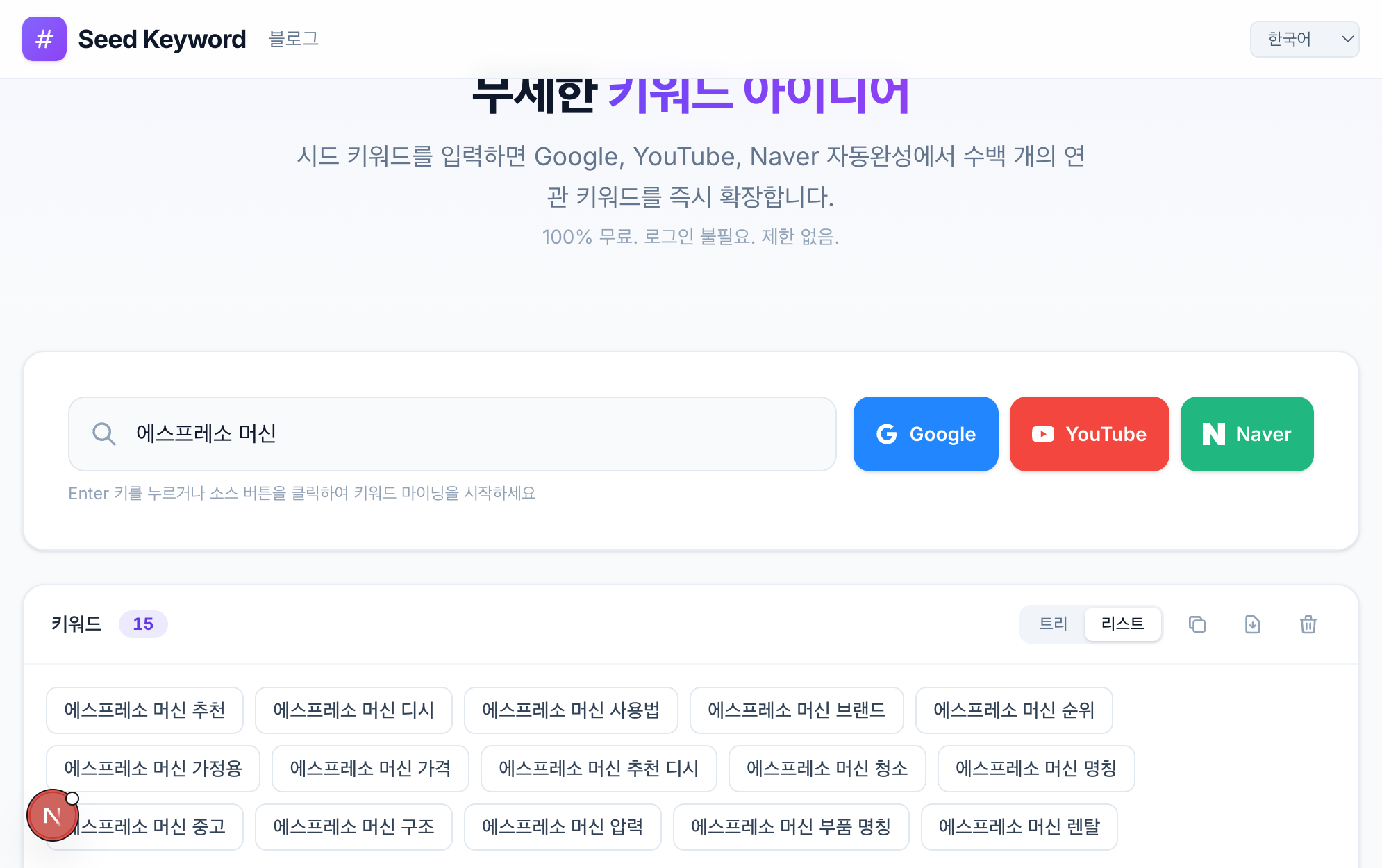
The same seed run through Naver instead of Google. These are Korean-language suggestions pulled straight from Naver's own autocomplete — the kind of phrases Ahrefs and Semrush routinely miss for the Korean market.
Naver DataLab (datalab.naver.com) is Naver's equivalent of Google Trends. Use it for seasonality and rising-topic detection. It also has a section showing the most-searched keywords by demographic, which is useful in ways Google Trends isn't.
Naver Knowledge iN. Underrated as a research source. People ask very specific questions there that they would never type as a Google query. Browsing Knowledge iN for your topic gives you a sense of intent and confusion in a way that pure keyword tools miss.
Practical advice for foreign companies trying to enter Korea
I get asked this often enough that I'll just answer it once.
You probably need a Naver Blog. Not because your external site can't rank (it can, in the Web section), but because Korean consumers expect to see a Naver Blog presence and treat its absence as a soft trust signal that something is off. This is not technically an SEO thing. It's a market expectation thing.
You probably need Korean content written by a Korean. Machine-translated Korean is not just bad SEO. It's bad to read, and Korean users disengage from translated text fast. The cost-per-article gap between machine translation and a competent Korean writer is real but worth it.
You probably do not need to obsess over Naver Search Advisor for your external site in the first six months. Set it up, submit the sitemap, then mostly forget about it. Your Naver Blog will deliver more traffic in less time.
What I think is overhyped
A lot of Naver SEO advice focuses on technical setup, hreflang, structured data, and so on. These things matter at the margin but I've seen too many small companies pour months into them while neglecting the actual content layer. If you have a clean site that loads fast and a Naver Blog publishing two or three times a week, you're ahead of probably 80% of foreign brands targeting Korea.
Most people lose at the content layer, not the technical layer.
Where Naver is heading
Naver has been slowly losing share to Google in younger demographics, especially for non-shopping queries. People under 25 in Korea increasingly default to Google and YouTube for general search, while Naver remains dominant for shopping, local, and Korean-language content. If your target audience skews young and non-shopping, Google in Korea matters more than people give it credit for.
But for Korean consumers above, say, 30, Naver is still the default. And the View section is where the eyeballs are.
That's the short version. There's more to say, but if you spend a month doing what I've described above, you'll be ahead of most of the Korean SEO content in English by a margin that frankly embarrasses me.